
Lap-Band Removal and Revision in Darien & Bolingbrook, IL
Medically reviewed by Sofiane El Djouzi, MD, FACSUpdated November 2026
If your Lap-Band is causing heartburn, vomiting or food getting stuck, or it has simply stopped working, you aren't alone. In one long-term study, about half of bands were removed within 12 years. I remove bands robotically and, for most patients, convert to a gastric sleeve or gastric bypass in the same operation. When the band has worn into the stomach or the tissue needs time to heal, I do it in two stages, up to three months apart.1,2
Why so many Lap-Bands come out
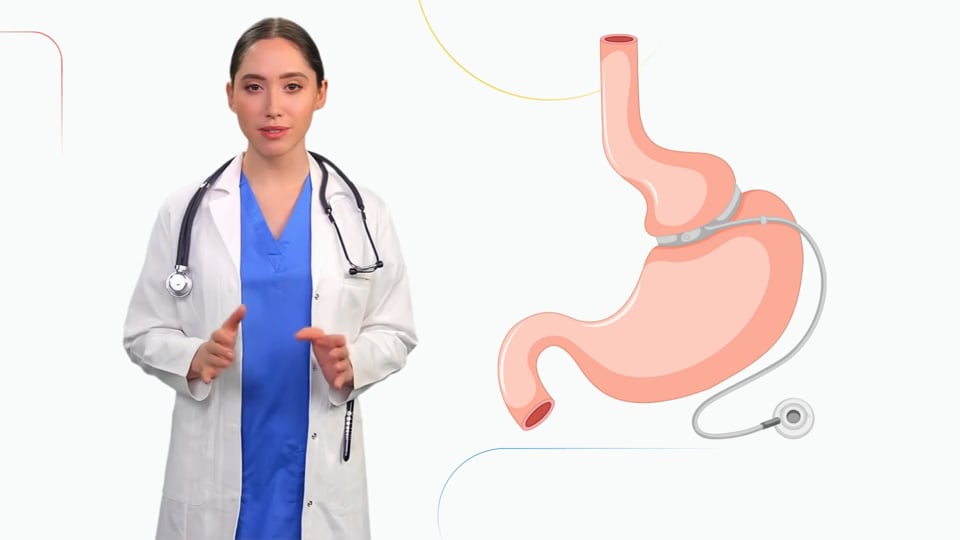
The adjustable gastric band is a silicone ring placed around the top of the stomach, with tubing to a port under the skin that's used for fills. For years it was one of the most common weight-loss operations in the U.S. Long-term results changed that. In a Belgian study of patients followed for at least 12 years, 39% had a major complication, 28% had the band wear into the stomach (erosion), about half had the band removed, and 60% needed another operation.1
Those bands were placed with an older technique, but newer series show the same pattern. A U.S. review of 200 band patients found that 28% needed another operation, most often for slippage (12%) or not losing enough weight (10%).2 U.S. surgeons placed 55,932 bands in 2011 and only 773 in 2023.3 Today, most people I see with a band come in to have it removed or replaced with a different operation.
I still offer the band, but rarely. It's for the few patients who have a medical reason they can't have another procedure and for whom the band is the best fit. For almost everyone else, a gastric sleeve or gastric bypass gives better, longer-lasting results. Read how a Lap-Band is placed.
Signs your band is a problem
- Heartburn or regurgitation, especially when you lie down at night.
- Vomiting or food getting stuck, or leaning on soft, high-calorie foods because solid food won't go down.
- Trouble swallowing or chest pain when you eat.
- Weight regain, or never losing as much as you hoped.
- Pain, redness or drainage at the port, which can signal infection or erosion.
When to go to the emergency room
If you suddenly can't keep down liquids or your own saliva, or you have severe belly pain, go to an emergency room. A slipped band can block the stomach and needs urgent care.
How I remove and revise a band
Almost every band can come out robotically, often through your old incisions. These are the steps:
- Small incisions. I work through a few small openings, often reusing old scars.
- Freeing the band. I open the scar capsule around the band, cut the band and remove it with its tubing.
- Removing the port. The port comes out from under the skin of your abdomen.
- Releasing old stitches. I take down the stitches that held the band in place so the stomach lies flat again.
- Checking the tissue. If the stomach wall is healthy, I convert to the new operation right away. If there's erosion, heavy scarring or inflammation, I stop and let it heal first.
- Conversion. Most revisions are done in this same operation. When I plan a staged revision, the sleeve, bypass or SADI-S follows up to three months later.
In straightforward cases, band removal takes less than an hour and you go home the same day. Removal with a conversion takes longer and usually means one or two nights at University of Chicago AdventHealth Bolingbrook Hospital, an MBSAQIP-accredited center.
Watch: Dr. El Djouzi on the Lap-Band
A 6-minute video from Dr. El Djouzi about the adjustable gastric band.
Your options after a band
Removing the band treats the symptoms, but without a new operation most patients regain weight. These are the options I discuss with every band patient:
Removal only
Best when you want the band out and aren't ready for another operation. Expect some weight to come back.
Band to sleeve
Removes about 80% of the stomach. A good fit for most patients without significant reflux, and often done in one operation.
About the sleeve →Band to bypass
My usual choice when reflux, a hiatal hernia or a stretched esophagus came with the band. A bypass treats reflux well.
About the bypass →Band to SADI-S
For a BMI of 50 or more or serious metabolic disease, such as hard-to-control type 2 diabetes, and only if you don't have reflux. It gives the most weight loss and requires lifelong vitamins and lab checks.
About SADI-S →When I'd leave a band alone
If you're at a weight you're happy with, eat normal food, and have no reflux, vomiting or swallowing trouble, the band doesn't have to come out. If it's been years since anyone checked it, I'd still look with an upper GI study or an endoscopy.
Weighing a conversion? The 60-second candidate quiz is a good first step before your consultation.
What results to expect
Results depend on the operation you convert to and why the band failed. In a multicenter study of 832 patients converted from a band to gastric bypass, average total weight loss was about 27% to 30% at close to three years.5 Weight loss after a revision is usually a little lower than after the same operation done first.
What usually improves
- Reflux and regurgitation usually ease once the band is out, especially after conversion to a bypass.
- Eating normal food again. Most patients can eat solid protein and vegetables instead of soft, easy-to-swallow foods.
- Steady weight loss after a conversion, with the same diet stages and support as a first-time operation.
Want a projection built on your own numbers? Try the weight-loss calculator.
Risks, and how we lower them
Revision surgery carries more risk than a first operation because of the scar tissue around a band. Even so, complication rates are low. A statewide study of 4,330 band conversions found fewer complications when the conversion was done in one operation, and fewer with a sleeve than with a bypass.6
Leak
Scar tissue and a thinner stomach wall raise leak risk a little in revisions. I check the tissue first and split the operation into two stages when it isn't ready.
Bleeding or injury from scar tissue
Dense scarring around the band can bleed or make tissue harder to separate. Robotic instruments give fine control in tight spaces.
Blood clots
Walking within hours of surgery, compression devices and preventive medicine lower the risk.
Weight regain after removal alone
Without a new operation, most patients regain weight. We plan the next step before the band comes out.
Reflux after a sleeve
A sleeve can cause or worsen heartburn. If you already had reflux with your band, a bypass is usually the better fit.
Vitamin deficiencies
After a bypass or SADI-S, lifelong vitamins and periodic labs prevent deficiencies.
Your recovery timeline
Your recovery depends on whether we remove the band only or convert in the same operation. These are typical ranges.
- Band removal onlyHome the same day in straightforward cases. Most people are back at desk work within about a week.
- Conversion: day of surgeryYou start walking within a few hours and take small sips of water.
- Days 1 to 2Most patients go home after one or two nights.
- Weeks 1 to 4Liquids, then puréed and soft foods, the same stages as a first-time sleeve or bypass. Most people return to desk work within about two weeks.
- Month 2 onwardRegular textures with protein first, follow-up visits and labs.
Our post-surgery instructions cover diet stages, medicines and warning signs in detail.
Insurance and self-pay
Most insurance plans cover band removal when the band is causing problems. Cigna's 2026 policy covers removal for slippage, a malfunction, or persistent nausea, vomiting or reflux, and covers conversion for a major complication or for weight-loss failure two or more years after the first operation.7 Blue Cross and Blue Shield of Illinois covers revision for complications such as a slipped band that adjustment can't fix, and for severe reflux that medicine doesn't control.8 Aetna covers band removal when your doctor recommends it.9
Conversion for weight regain alone usually needs more documentation, such as records showing you followed the diet and visit schedule after your band.8 We verify your benefits for free before your first visit. If you'd rather self-pay, revision pricing is quoted after your consultation, and financing is available. See insurance and financing and bariatric surgery cost.
Sleeve or bypass after a band?
Reflux, a hiatal hernia or a stretched esophagus point toward a bypass. Without those, a sleeve is a good option, and converting to a sleeve carries slightly less risk.6 Read more on sleeve vs. bypass and revision surgery.
Questions patients ask me about Lap-Band removal
Does my Lap-Band have to come out?
Not always. If you're at a weight you're happy with, eat normal food, and have no reflux, vomiting or swallowing trouble, the band can stay. If it's been a few years, I still recommend a check with an upper GI study or an endoscopy, because some band problems develop quietly.
Will I gain weight after the band is removed?
Most patients do if the band comes out without another operation. That's why I usually convert to a sleeve or bypass in the same surgery. When a staged revision is the safer plan, the second operation follows up to three months later.
Can you remove the band and do the sleeve or bypass in the same surgery?
Usually, yes. A review of 3,895 conversions found similar complication and leak rates for one-stage and two-stage approaches, and a statewide study found fewer complications with one-stage conversion.4,6 I choose two stages, up to three months apart, when the band has eroded or the stomach wall is inflamed or heavily scarred.
Should I convert to a sleeve or a gastric bypass?
Reflux, a hiatal hernia or a stretched esophagus point toward a bypass, which treats reflux well. Without those, a sleeve is a reasonable choice with slightly lower risk. With a BMI of 50 or more or serious metabolic disease, and no reflux, SADI-S is another option. We decide together after your endoscopy and imaging.
Does insurance cover Lap-Band removal?
Usually, when the band is causing symptoms or a complication.7,8,9 Coverage for conversion because of weight regain depends on your plan and your records. We verify your benefits before your first visit, so you know what's covered.
Is Lap-Band surgery still done?
Rarely. The gastric sleeve and gastric bypass give better, longer-lasting results, so they've replaced the band for almost everyone. I still offer a band to the few patients who have a medical reason they can't have another procedure and for whom it's the best fit. Far more often, my work with the Lap-Band is removing it and converting to a sleeve, a bypass or SADI-S. Read about Lap-Band placement.
What are the signs of a slipped or eroded band?
A slipped band often causes sudden vomiting, trouble keeping liquids down, severe heartburn or pain. An eroded band may cause a port infection, a loss of restriction or upper belly pain. If you can't keep down liquids or saliva, go to an emergency room right away.
Patient reviews
What do patients say about Lap-Band removal and revision?
I underwent gastric bypass surgery. I previously had lap band surgery so the bypass included removal of the lap band. Dr. El Djouzi and his team were great to work with! They answered all of my questions and made sure I left the consultation with a full understanding of not only the procedure but also the expectations leading up to and after the surgery.
★★★★★
Kristin, Google review
I found Dr. El Djouzi through my original surgeon, who does not perform gastric bypass surgery. From the moment I met Dr. El Djouzi, I knew I had found the right surgeon. He is compassionate, incredibly knowledgeable, and truly listens to his patients.
★★★★★
Deanne, Google review
These are public Google reviews, shown with first names only. Read all reviews on Google.
Ready to talk about your band?
Virtual or in-person consultations in Darien and Bolingbrook. We go over your band history with you and verify your insurance before your first visit.
No referral needed · Consultations in as little as 48 hours · Hablamos Español · Call 773-365-1300
Sources
- Himpens J, Cadière GB, Bazi M, et al. Long-term outcomes of laparoscopic adjustable gastric banding. Arch Surg. 2011;146(7):802-807. DOI
- Mellert LT, Cheung M, Berbiglia L, et al. Reoperations for long-term complications following laparoscopic adjustable gastric banding: analysis of incidence and causality. Cureus. 2020;12(5):e8127. DOI
- American Society for Metabolic and Bariatric Surgery. Estimate of bariatric surgery numbers, 2011 to 2023. ASMBS
- Marion Y, Eid Y, Menahem B, et al. What to propose after failed adjustable gastric banding: one- or two-step procedure? World J Surg. 2020;44(10):3423-3432. PubMed
- Pujol-Rafols J, Al Abbas AI, Devriendt S, et al. Conversion of adjustable gastric banding to Roux-en-Y gastric bypass in one or two steps: what is the best approach? Analysis of a multicenter database concerning 832 patients. Obes Surg. 2020;30(12):5026-5032. DOI
- Spaniolas K, Yang J, Zhu C, et al. Conversion of adjustable gastric banding to stapling bariatric procedures: single- or two-stage approach. Ann Surg. 2021;273(3):542-547. DOI
- Cigna. Medical Coverage Policy 0051, Bariatric Surgery and Procedures. 2026. Policy
- Blue Cross and Blue Shield of Illinois. Medical policy SUR716.003, Bariatric Surgery. Effective January 1, 2026. Policy
- Aetna. Clinical Policy Bulletin 0157, Obesity Surgery. Policy
This page is general information, not medical advice. Results vary from person to person. Talk with Dr. El Djouzi about what to expect in your case.