
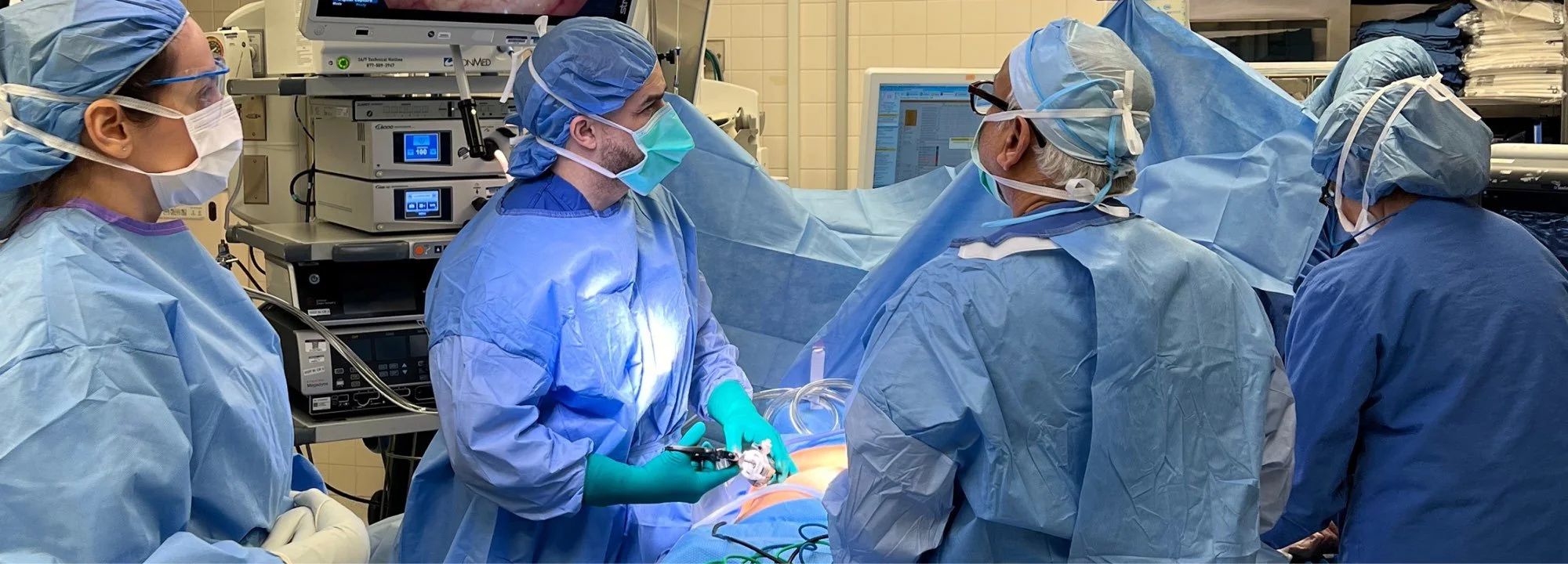
Bariatric Revision Surgery in Darien & Bolingbrook, IL
Weight came back. Reflux never left. Or the first operation never delivered what it was meant to. None of that means you failed, and none of it means you are out of options. A revision is a second bariatric operation that converts, repairs or corrects the first one. I perform revisions robotically at University of Chicago AdventHealth Bolingbrook Hospital, for patients whose first surgery was done by me, by another surgeon in Illinois, in another state or abroad.
Watch: Dr. El Djouzi introduces bariatric revision surgery.
Why do sleeves, bypasses and bands stop working?
Bodies adapt. Anatomy changes. Some operations simply stop delivering after several years, and that is a known part of bariatric care rather than a verdict on you. After a gastric sleeve, four reasons account for most of the patients who come back to me:
- Weight regain. The most common reason, and usually the hardest one to talk about. The stomach adapts, hunger hormones recover and old patterns return.
- Sleeve dilation. Over time the remaining stomach can stretch, and the restriction that made the sleeve work fades.
- Reflux. A sleeve can worsen acid reflux or bring it on for the first time. When medication stops controlling it, a conversion is often the durable fix.
- Not enough weight loss to begin with. Some patients never reach the result the operation was meant to deliver.
After a gastric bypass, the usual problems are an enlarged pouch or a widened connection to the intestine, both of which let you eat more before you feel full, and less often a narrowing or an ulcer at that connection. After a lap band, the band can slip, erode into the stomach or simply stop being tolerated, with nausea, vomiting or reflux as the signal.
Which of these applies to you changes which revision makes sense. That is why the imaging and the endoscopy come before any recommendation, and why the honest answer is sometimes that you do not need an operation at all. Regain after bariatric surgery has physiologic causes, and for many patients weight loss medication after bariatric surgery restores the result without a second surgery. Medication first, a revision if your anatomy warrants it, or both over time, all from the same physician in the same office.
Which revision fixes weight regain after a sleeve?
It depends on what the sleeve looks like now. If the sleeve is intact and the regain is hormonal and behavioral, medication and a structured program may be the right first move, and I will say so. If the sleeve has stretched, or if it was made too wide to begin with, the options are:
- Sleeve to gastric bypass. The usual answer when reflux is part of the picture, and a strong option for regain on its own. The sleeve is reshaped into a small pouch and the small intestine is rerouted to it.
- Sleeve to SADI-S. A malabsorptive conversion for patients who need more weight loss than a bypass conversion would give. The existing sleeve is usually kept, and only the intestinal bypass is added. It asks more of you afterwards: daily vitamins for life and blood work on a schedule. Read more about SADI-S.
- Re-sleeve. Narrowing a dilated sleeve with a new staple line. It is the right choice for a small group of patients and the wrong one for most, because the problems that stretched the first sleeve tend to stretch the second.
- Endoscopic tightening. Reducing a dilated sleeve or pouch from the inside, with no incisions. Insurers currently classify endoscopic revision as unproven, so it is a self-pay option, and I will tell you plainly whether it fits your anatomy.
Anyone quoting you a weight-loss number before reviewing your anatomy is guessing. You will get a realistic range from me after I have seen your imaging and your operative report.
When is sleeve to gastric bypass the right conversion?
Three situations point me toward a bypass conversion. The first is reflux that medication no longer controls, especially when the endoscopy shows damage to the lining of the esophagus. The bypass takes the acid-producing part of the stomach out of the food stream, which is why it is the operation that reliably treats reflux. The second is weight regain with a dilated sleeve, where the bypass adds a hormonal effect the sleeve never had. The third is type 2 diabetes that is not well controlled after the sleeve, where the bypass does more for blood sugar.
The conversion is done robotically through the same small incisions as a first operation. Most patients go home after a short hospital stay and return to desk work within about two weeks.
What if my lap band failed?
Bands fail in two ways: mechanically, when they slip or erode into the stomach, and functionally, when the weight comes back or the band is never tolerated. The choices are removal alone, or removal with conversion to a sleeve or a bypass. When the tissue around the band is healthy I do the removal and the conversion in one operation. When the band has eroded or the stomach wall is inflamed, it is wiser to remove the band first, let the tissue heal, and convert a few months later. Insurers generally cover band removal for symptoms and cover conversion when the band has slipped or malfunctioned and cannot be fixed with an adjustment. Read more about lap band removal and revision.
What can be done about reflux after a sleeve?
Reflux after a sleeve is common enough that I scope every patient before a first operation to look for it, and it is the single most common reason for a sleeve revision. The work-up is specific, because every insurer asks for the same proof:
- Upper endoscopy to look for esophagitis, a hiatal hernia, and changes to the lining of the esophagus known as Barrett's.
- Imaging, usually an upper GI study, and in some cases 24-hour pH monitoring, to show how much acid is coming up and whether the sleeve is kinked or twisted.
- A fair trial of medication, meaning at least a month of a double-dose proton pump inhibitor plus the positional and dietary changes your insurer will want documented.
If the reflux persists after that, conversion to a gastric bypass is the standard answer. When the cause is a hiatal hernia and the sleeve itself is in good shape, repairing the hernia alone can be enough. Years of reflux can change the lining of the esophagus, so patients with Barrett's are watched with surveillance endoscopy whether or not they have a revision.
How do you decide which revision I need?
Candidacy for a revision is judged differently than for a first operation. I look at what your anatomy looks like now, why the first procedure stopped working, whether there is a mechanical problem to correct, and whether your overall health supports a second operation. Before anyone recommends anything, expect:
- Your original operative report. It tells me what was actually done, which matters more than what the procedure was called. If you cannot find it, our team will help you request the records.
- An upper endoscopy, which I perform myself, to see the sleeve, pouch or band from the inside.
- Imaging, an upper GI series or a CT scan, to measure the size and shape of what is there.
- Blood work, including vitamin and protein levels, because deficiencies have to be corrected before a second operation.
- A nutrition assessment with our dietitian and a behavioral health evaluation, both of which most insurers require again for a revision.
- A body composition scan, so we measure fat and muscle separately instead of guessing from the scale.
Sometimes the honest answer is that a revision is not the right move, and medication, endoscopic treatment or focused nutritional work would serve you better. You will hear that from me if it is the case.
Does insurance cover revision surgery?
Sometimes, and the rules are stricter than for a first operation. All four plans we work with cover a revision when there is a documented complication: a leak, a stricture or obstruction, a staple-line failure, a band that has slipped or eroded, or severe reflux that medication does not control. Weight regain by itself is where the plans differ, and this is what their current policies say:
- Blue Cross Blue Shield of Illinois (policy SUR716.003, effective January 1, 2026) covers revision for complications, for severe reflux that does not respond to treatment, and for a pouch that has dilated, documented by an upper GI study or endoscopy, when the first operation worked before the dilation and you followed the prescribed nutrition and exercise program.
- Cigna (policy 0051, effective July 15, 2026) covers revision or conversion for a major complication, including reflux that medication does not control. Without a complication, it covers a revision when weight loss failure is two or more years after the first operation and you meet the first-time criteria again: a multidisciplinary evaluation within the past 12 months with a mental health clearance, a nutrition evaluation and documentation that medical weight management did not hold.
- Aetna (clinical policy bulletin 0157) covers conversion of a sleeve to a bypass or duodenal switch when the first operation did not produce sustained weight loss by two years and you followed the nutrition and exercise plan. For reflux it wants the problem documented by an upper GI study, pH monitoring or esophagitis on endoscopy, and not controlled after at least a month of twice-daily acid medication plus lifestyle changes.
- UnitedHealthcare (policy 2026T0362RR, effective May 1, 2026) covers revision only for a technical failure or major complication. For reflux after a sleeve it requires failed medical management and grade C or D esophagitis on endoscopy. It lists revision for any other reason, including weight regain on its own, as unproven, and it currently lists SADI-S as unproven as well.
Your own plan document can exclude bariatric surgery or revisions entirely, whatever the carrier's policy says. We verify your benefits at no cost before you commit to anything, we build the documentation packet, and we write the appeal when a case is worth fighting for. How insurance approval works, plan by plan.
What does revision surgery cost if I pay myself?
Revisions are quoted individually, because a band removal and a sleeve-to-SADI-S conversion are not the same operation. You will have your number in writing at your consultation, before you commit to anything. The package covers my surgical fee, anesthesia, the hospital facility fee and your hospital stay, every post-operative visit with me for six months, nutritionist consultations, and our support sessions and private patient group. Pre-operative testing and specialist clearances are billed separately, and your insurance will often pay for those even when it excludes the surgery itself. Financing is available through MD Save, a third-party partner whose approval runs on their criteria, not ours. See self-pay prices for every procedure.
How is robotic revision surgery different?
Scar tissue from the first operation makes the anatomy less predictable, and the tissue itself handles differently. That is the main reason a revision carries somewhat more risk than a first operation, and you should hear that plainly. It is also why I perform most revisions robotically. From the console I control instruments that bend and rotate like a wrist, with a magnified three-dimensional view inside your abdomen, which matters most when I am dissecting around old staple lines in a tight space. The robot never moves on its own. It translates my hands.
Revisions take place at AdventHealth Bolingbrook, an MBSAQIP-accredited bariatric center recognized as a Blue Distinction Center for bariatric surgery, with a full multidisciplinary team. At your consultation you will get the specific risks for your specific anatomy, not a generic list.
What is recovery like after a revision?
Most revisions are done robotically or laparoscopically, so recovery resembles your first surgery: a short hospital stay, a staged diet from liquids back to solids, and a return to light activity within a couple of weeks. A conversion to SADI-S typically means two nights in the hospital and four to six weeks to full activity. More complex revisions, particularly where extensive scar tissue is involved, can mean a longer stay and a slower return to full activity.
Follow-up matters more the second time around. Regular visits, nutritional support, lab work and, after a bypass or SADI-S, daily vitamins protect the result you just paid for, in effort and often in money.
Patient reviews
What do patients say about their revision surgery?
I definitely wanted to post for the people that are questioning whether they should do it or not. I just had my procedure a gastric revision to the bypass done yesterday. I feel much better today than I did yesterday and the office and the nurses and the doctor have all been amazing they've answered every question I have they definitely are an amazing support system.
★★★★★
Nichole, Google review, 2022
I found Dr. El Djouzi through my original surgeon, who does not perform gastric bypass surgery. From the moment I met Dr. El Djouzi, I knew I had found the right surgeon. He is compassionate, incredibly knowledgeable, and truly listens to his patients.
★★★★★
Deanne, Google review, 2026
I am so excited to find Dr. Djouzi! I had a sleeve performed five years ago, and I did not lose nearly as much as I had hoped. For the last 3 years, I have carried around the burden of failure. However, I am changing my outlook, and it was not a failure, but an opportunity to learn that my health is too important not to try again.
★★★★★
Mary, Google review, 2023
Dr. Djouzi is an awesome person, very detailed and he took his time. Any questions I had he answered. I am so excited to finally be one his patients. I have been battling weight gain for years and I need a revision. Dr Djouzi is the best option out there to do just that!!! Highly recommended!!!
★★★★★
Brandy, Google review, 2023
I just completed my consultation with Dr. El Djouzi he was very informative, very helpful and inspirational. I had a ESG with a Dr in NC that did not give me the results I hoped for So I am looking to have a revision. Dr El Djouzi gave me all the information that I needed to make a informed decision. He is very patient and knowledgeable he has shared his experience and years of knowledge.
★★★★★
Vernetta, Google review, 2022
These are public Google reviews, shown with first names only. Read all reviews on Google.
Why do patients come to Dr. El Djouzi for a second operation?
Revision surgery is more complex than a first sleeve, and it calls for a surgeon who corrects anatomy rather than only creating it. Dr. El Djouzi is dual board-certified in General Surgery and Obesity Medicine, fellowship-trained in advanced gastrointestinal, minimally invasive and bariatric surgery at the University of Nebraska Medical Center, a Fellow of the American College of Surgeons, the Royal College of Surgeons of England and the American Society for Metabolic and Bariatric Surgery, and a former Assistant Professor of Surgery at Loyola University. He has performed more than 2,400 bariatric procedures, presented at the ASMBS annual meeting and published on the long-term outcomes of bariatric surgery.
A large share of his revision patients had their first surgery somewhere else: a different surgeon, a different hospital, sometimes a different country. Consultations are in Darien or Bolingbrook, whichever office is nearer, or by video, usually within 48 hours. Hablamos Español.
No referral needed · Hablamos Español · Most major insurance accepted
What else do patients ask about revision surgery?
I had my first surgery somewhere else. Can you still help?
Yes, and a large share of our revision patients are in exactly that position. Bring your original operative report if you have a copy. It tells us what was actually done, which matters more than what the procedure was called. If you cannot find it, our team will help you request the records.
Is revision surgery riskier than the first operation?
It carries somewhat more risk, and you should hear that plainly. Scar tissue from the first operation makes the anatomy less predictable, and the tissue itself handles differently. That risk is manageable in experienced hands, at an accredited center, with the work-up done properly beforehand. At your consultation you will get the specific risks for your specific anatomy.
Can a stretched sleeve be made smaller again?
Sometimes. A re-sleeve narrows the stomach with a new staple line, and endoscopic tightening does it from the inside. Both have a place for a small group of patients. For most people with regain, converting to a bypass or SADI-S holds up better, because the forces that stretched the first sleeve are still there.
How much weight will I lose after a revision?
Less than after a first operation, as a rule, and the honest range depends on which revision you have and why you are having it. A sleeve-to-bypass conversion done for reflux is aimed first at fixing the reflux. A conversion done for regain, particularly to SADI-S, targets weight directly. You will get a realistic range once I have seen your imaging and your operative report.
How long after my first surgery can I have a revision?
A complication is treated when it appears, whether that is six months or ten years out. For weight regain, insurers generally want to see two years since the first operation and evidence that you followed the program in between. Self-pay patients are not bound by that timeline, but the two-year mark is also when I can tell a stretched sleeve from a sleeve that was never given a fair chance.
Do I have to repeat the supervised diet and the psychological evaluation?
Usually some of it. Most plans want a fresh behavioral health clearance and a nutrition evaluation before a revision, and Cigna asks you to meet the first-time criteria again when the reason is weight regain rather than a complication. We schedule those visits and document every one so the packet is not rejected on a technicality.
What should I bring to the consultation?
Your original operative report, any endoscopy or imaging reports since, a list of your medications, and your insurance card. If you have been on a GLP-1 medication, tell us when you started it and at what dose. If you have none of the records, come anyway. We know how to request them.
How soon can I be seen?
Usually within 48 hours, in Darien, in Bolingbrook or by video.
Sources
- Blue Cross and Blue Shield of Illinois. Medical Policy SUR716.003, Bariatric Surgery, effective January 1, 2026. bcbsil.com
- Cigna. Medical Coverage Policy 0051, Bariatric Surgery and Procedures, effective July 15, 2026. cigna.com
- Aetna. Clinical Policy Bulletin 0157, Obesity Surgery. aetna.com
- UnitedHealthcare. Commercial Medical Policy 2026T0362RR, Bariatric Surgery, effective May 1, 2026. uhcprovider.com
- American Society for Metabolic and Bariatric Surgery. Bariatric Surgery Procedures. asmbs.org
This page is general information, not medical advice. Insurance criteria and prices change. Talk with Dr. El Djouzi and our office about what applies in your case.